
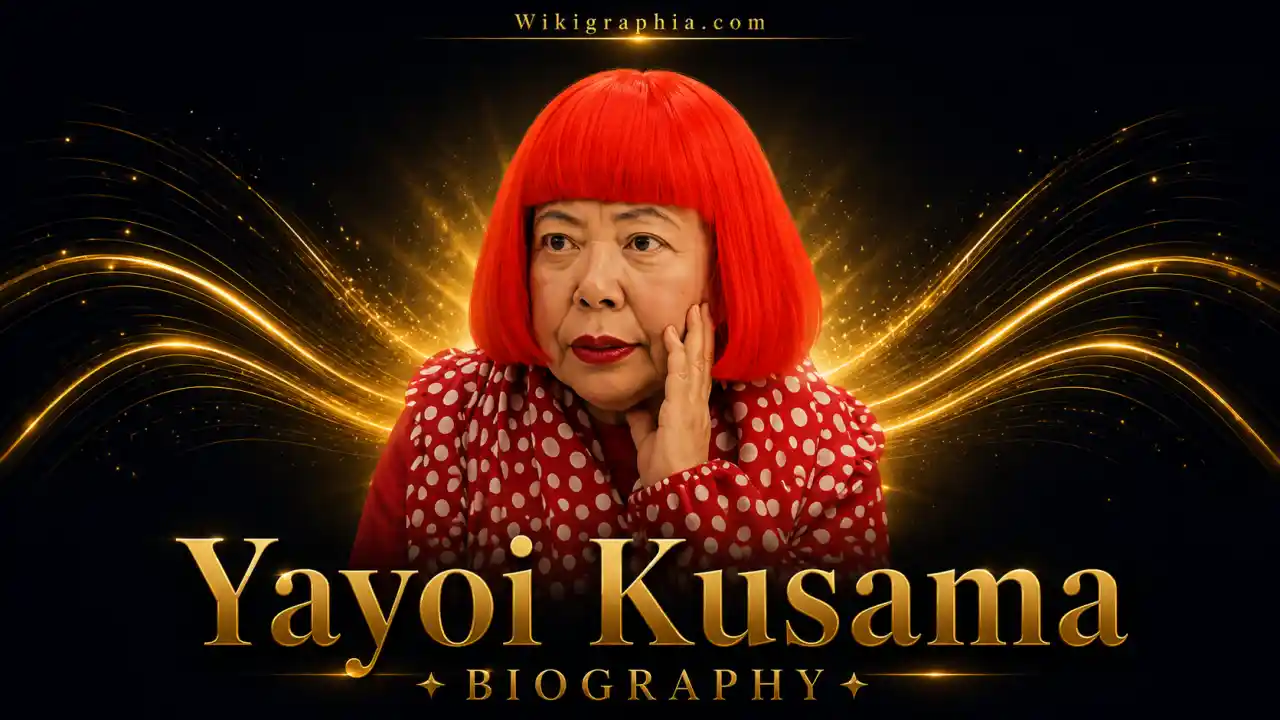
Yayoi Kusama was a Japanese artist born on March 22, 1929, in Matsumoto, Japan, who died on August 14, 2026, in Tokyo at the age of 97. She was a self-described obsessional artist whose polka dots, infinity mirror rooms, and pumpkin sculptures made her the most visited living artist in the world for much of the 21st century. She spent more than seven decades working in painting, sculpture, installation, performance, writing, and fashion, and she continued to paint until her final days.
Yayoi Kusama Biography, Wiki
| Field | Details |
| Full Name | Yayoi Kusama (草間 彌生) |
| Date of Birth | March 22, 1929 |
| Date of Death | August 14, 2026 |
| Age at Death | 97 years old |
| Birthplace | Matsumoto, Nagano Prefecture, Japan |
| Hometown | Tokyo, Japan (from 1977 onward) |
| Nationality | Japanese |
| Religion | Not publicly confirmed |
| Caste or Community | Not applicable |
| Zodiac Sign | Aries |
| Height | Not publicly confirmed |
| Weight | Not publicly confirmed |
| Eye Colour | Dark brown |
| Hair Colour | Red (dyed; her signature look in later decades) |
| Profession | Artist, Sculptor, Installation Artist, Painter, Writer |
| Known For | Polka dot paintings, Infinity Mirror Rooms, pumpkin sculptures, Infinity Nets series |
| Father’s Name | Shigeru Kusama |
| Mother’s Name | Kamon Okamura |
| Siblings | Three elder siblings (names not publicly confirmed) |
| Marital Status | Never married |
| Spouse | None |
| Relationship | Joseph Cornell (close relationship, 1962 until his death in 1972) |
| Children | None |
| School | Matsumoto Arigasaki High School |
| College or University | Kyoto Municipal School of Arts and Crafts (now Kyoto City University of Arts) |
| Degree or Qualification | Training in Nihonga traditional painting; one year (1948) |
| Political Party | N/A |
| Current Position or Role | Deceased (August 14, 2026) |
| Net Worth (estimated) | Approx. $100 million USD (various estimates; not officially confirmed) |
| Monthly Income (estimated) | Not publicly confirmed |
| Twitter/X | Not publicly confirmed |
| @yayoikusama_ (official managed account) | |
| Not publicly confirmed | |
| YouTube | Not publicly confirmed |
| Official Website | yayoi-kusama.jp |
Yayoi Kusama Selected Major Works
| Year | Work | Medium | Notes |
| 1958-65 | Infinity Nets | Painting series | Signature white-on-white net canvases; launched New York reputation |
| 1963 | Accumulation No. 1 | Soft sculpture | Phallus-covered armchair; pioneering Pop Art object |
| 1965 | Infinity Mirror Room: Phalli’s Field | Installation | First mirror room; groundbreaking spatial work |
| 1965 | Driving Image Show | Installation | Immersive environment; shown in New York |
| 1966 | Narcissus Garden | Performance/installation | Venice Biennale (unofficial); silver mirrored balls |
| 1994 | Pumpkin (Yellow) | Sculpture | Naoshima, Japan; outdoor site-specific; became icon |
| 2002 | Obliteration Room | Interactive installation | Visitors add polka dot stickers to white room |
| 2006 | Dots Obsession | Installation | Inflatable polka-dot spheres; toured globally |
| 2012 | I Who Have Arrived in Heaven | Infinity Mirror Room | Major MoMA retrospective centrepiece |
| 2013 | The Souls of Millions of Light Years Away | Infinity Mirror Room | Part of Infinity Mirrors touring exhibition |
| 2009 | My Eternal Soul | Painting series | Large-scale, vibrantly coloured; continued until death |
Yayoi Kusama Awards and Achievements
| Year | Award | Given By | Notes |
| 1993 | Japanese representative, Venice Biennale | Japan / Venice Biennale | Major international recognition |
| 2006 | Praemium Imperiale (Painting) | Japan Art Association | Among the world’s highest art honours |
| 2009 | Person of Cultural Merit | Government of Japan | Imperial designation |
| 2016 | Order of Culture | Imperial Family of Japan | One of Japan’s highest civil honours |
| 2016 | Time 100 Most Influential People | Time magazine | Named to annual list |
Yayoi Kusama Events
| Year | Event |
| 1929 | Born March 22 in Matsumoto, Nagano, Japan |
| c. 1939 | First hallucinations; begins drawing polka dots and nets as a coping mechanism |
| 1944-45 | Works in a parachute factory during World War II |
| 1948 | Enrolls at Kyoto Municipal School of Arts and Crafts; studies Nihonga painting |
| 1952 | First solo exhibition in Japan |
| 1955 | Writes to Georgia O’Keeffe seeking advice; O’Keeffe responds encouragingly |
| 1957 | Moves to New York; burns work she cannot carry |
| 1958 | Begins Infinity Nets series; establishes avant-garde reputation |
| 1962 | Meets Joseph Cornell; begins close relationship |
| 1963 | Creates Accumulation No. 1 (soft sculpture) |
| 1965 | Creates first Infinity Mirror Room (Phalli’s Field) |
| 1966 | Unofficial participation in Venice Biennale with Narcissus Garden |
| 1966-68 | Stages Happenings in New York; prominent in counterculture |
| 1972 | Joseph Cornell dies |
| 1973 | Returns to Japan |
| 1977 | Voluntarily enters psychiatric hospital in Tokyo (Seiwa Hospital); continues working from studio nearby |
| 1989-90 | Retrospective at Center for International Contemporary Arts, New York; international reputation revives |
| 1993 | Represents Japan at Venice Biennale; international recognition renewed in Japan |
| 1998-99 | Love Forever retrospective tours LACMA, MoMA, Walker Art Center |
| 2006 | Receives Praemium Imperiale |
| 2011-12 | Major retrospective opens at Reina Sofía, Madrid; travels to Centre Pompidou, Tate Modern |
| 2012 | Louis Vuitton collaboration (with Marc Jacobs); global cultural phenomenon |
| 2017 | Yayoi Kusama Museum opens in Tokyo’s Shinjuku district |
| 2017-18 | Infinity Mirrors touring exhibition breaks attendance records across North America |
| 2024-25 | NGV Melbourne retrospective draws 570,537 tickets; most attended ticketed art exhibition in Australian history |
| 2025-26 | European retrospective opens at Fondation Beyeler; tours to Museum Ludwig and Stedelijk |
| August 14, 2026 | Dies at a hospital in Tokyo, age 97 |
| August 27, 2026 | Death announced by Yayoi Kusama Inc. via official website |
Yayoi Kusama Early Life and Family
Matsumoto in the 1930s was a prosperous provincial city in the mountains of central Japan, and the Kusama family occupied a respectable place within it. Yayoi Kusama was born in 1929, the youngest daughter of a family from the mountainous region of Matsumoto in central Japan. Her family made their living from the cultivation of plant seeds. The business gave them comfort, but little else about her childhood was easy.
Her parents were the product of a loveless arranged marriage. Her mother was physically and verbally abusive, while her father was a womanizer. Her mother would send her to spy on her father’s affairs, an experience Kusama later said gave her a lasting aversion to male sexuality that found its way directly into her art. She was the youngest of four children, and she began drawing obsessively from around age ten.
Yayoi Kusama Father
Her father’s name was Shigeru Kusama. He took his wife’s surname as a condition of marriage into the affluent Okamura family, a social arrangement that sources suggest left him emasculated and largely absent from family life. His repeated infidelities formed the backdrop to Kusama’s childhood and contributed to the psychological intensity that would define her art.
Yayoi Kusama Mother
Her mother’s name was Kamon Okamura. She ran the household and the family seed business with severity. She discouraged her young daughter’s dreams of becoming a professional artist, trying to steer her instead towards the conventional path of a traditional Japanese housewife. When her mother tore her drawings away from her, Kusama made more. When she could not afford to buy art supplies, she used materials she found around the home.
Yayoi Kusama Siblings and Family Background
Kusama was the youngest of four children. The names of her three elder siblings are not publicly confirmed in any credible source. After the outbreak of the Second World War, Kusama, like other school-age children in her hometown, was called upon to work for up to twelve hours a day in a parachute factory. That wartime experience of enforced repetition, of sewing the same stitch again and again, reinforced patterns of thought and making that would run through her entire career.

Yayoi Kusama Education
The school gave Yayoi Kusama a framework she repeatedly pushed against. She attended Matsumoto Arigasaki High School and began experiencing visual hallucinations from around age ten, describing flashes of light, auras, and dense fields of dots that seemed to consume the world around her. She painted to neutralise them.
In 1948, despite her parents’ opposition, she enrolled at the Kyoto Municipal School of Arts and Crafts, where she learned the traditional Nihonga painting style of Japan. She stayed for one year. The style, with its careful mineral pigments and classical Japanese forms, engaged her technically but not creatively. She left seeking something that the curriculum had no interest in teaching.
Yayoi Kusama Career
No single trajectory captures what Yayoi Kusama did across nearly eight decades of work. She moved from provincial Japan to New York’s avant-garde, from obscurity to the world’s most attended living artist, from the margins of the 1960s counterculture to Louis Vuitton storefronts on every continent, and she did it all while living voluntarily in a psychiatric hospital from the age of 47.
Yayoi Kusama in Japan and the Move to New York
Her talents flourished after her move to the US in 1957, producing from her New York studio various works in different genres, making her a heroine of the European and American art scenes in the 1960s. Before leaving, she burned the paintings she could not transport, destroying the evidence of her early years in Japan to begin entirely from scratch.
She had written to the American painter Georgia O’Keeffe in 1955, seeking advice on how to establish herself. O’Keeffe replied with encouragement. Kusama took it seriously.
Yayoi Kusama in New York: Infinity Nets, Happenings and the 1960s
Her first years in New York produced the Infinity Nets, enormous canvases painted with obsessively repeated arcs in white on white, producing a shimmering optical field that left viewers uncertain where the painting ended and the air began. The works attracted serious critical attention and placed her among the city’s most significant emerging artists.
In 1961, she started making her iconic soft sculptures. The next year, she met Joseph Cornell, an American artist known for his intricate assemblages of found objects in shadow boxes. They remained in contact until he died in 1972. Their relationship was one of the most discussed in art world history, a deep creative and personal bond that Cornell documented extensively in his diaries.
Her Infinity Mirror Rooms followed in 1965, starting with Phalli’s Field, a mirrored room filled with fabric phalluses covered in polka dots. The piece was immediately recognised as something new in the history of art. She employed painting, sculpture, performance art, and installations in a variety of styles, including Pop Art and Minimalism. Her early airmail-sticker collages, egg carton reliefs, and phallus-covered objects are considered significant in the history of American Pop Art and Post-Minimalist abstraction.
Yayoi Kusama Returns to Japan
Kusama returned to Japan in 1973 after more than a decade in New York. In 1977, she voluntarily entered a psychiatric hospital in Tokyo. She continued making art and writing while living there, working from a studio nearby. The decision was not a retreat. It was a structure she chose for herself, a daily routine that kept her producing work at a pace that would have exhausted artists half her age.
Yayoi Kusama International Recognition and Legacy
Her international reputation grew again from the late 1980s onward. The 1993 Venice Biennale gave her work renewed exposure, followed by retrospectives at museums in Europe, Asia and North America. A major touring retrospective in 2011 to 2012 opened at the Reina Sofía in Madrid, moved to the Centre Pompidou in Paris, and concluded at Tate Modern in London, each stop breaking the museum’s own attendance records.
The 2024 to 2025 NGV Melbourne retrospective sold 570,537 tickets, the most attended ticketed art exhibition in Australian history. Her European retrospective, which opened at Fondation Beyeler in 2025 and toured to Museum Ludwig in Cologne, was still running at the Stedelijk Museum in Amsterdam when she died in August 2026.
Throughout an extraordinary lifetime devoted entirely to artistic creation, Kusama pursued an internationally acclaimed career as a pioneering avant-garde artist whose creative practice encompassed visual art, performance, fiction, and poetry. She continued to paint until her final days, never setting aside her brush.
Yayoi Kusama Art, Exhibitions and Publications
Yayoi Kusama represented a rare convergence of critical seriousness and mass popular appeal. Museums struggled to manage the queues her shows generated, and auction houses watched her works break records with regularity.
Yayoi Kusama Signature Works and Movements
Her work touched Pop Art, Minimalism, feminist art, Surrealism, and Art Brut without settling into any of them. Her highly influential career encompassed paintings, performances, room-size presentations, outdoor sculptural installations, literary works, films, fashion, design, and interventions within existing architectural structures, which allude at once to microscopic and macroscopic universes.
The Obliteration Room, first created in 2002, invited visitors to apply polka dot stickers to a pristine white room until it was entirely covered. The piece dissolved the boundary between audience and artwork in a way that anticipated the participatory culture of the internet age by a decade. Her My Eternal Soul series, begun in 2009 and continued until her death, comprised hundreds of large-scale paintings executed with the same obsessive energy she had applied at ten years old in Matsumoto.
Yayoi Kusama as a Writer
She published several novels and collections of poetry across her career, including Christopher Wool (1983) and Woodstock Phallus Cutter (1988). Her autobiography, Infinity Net, was published in English translation in 2011 and became an important document of the New York art world of the 1960s as well as a frank account of her psychological life.
Yayoi Kusama Museum and Representation
The Yayoi Kusama Museum opened in Tokyo in 2017. Her galleries are Ota Fine Arts (Tokyo, Singapore, Shanghai), David Zwirner (New York), and Victoria Miro (London). Her auction records have consistently placed her among the world’s top-selling living artists, with major works achieving seven-figure sums.
Yayoi Kusama Religion and Community
What is Yayoi Kusama’s Religion
Yayoi Kusama’s religion is not publicly confirmed in any credible source. She did not make public statements about religious faith. Her art engaged extensively with themes of infinity, self-obliteration, and the dissolution of the self into the cosmos, a spiritual dimension that commentators have noted without attributing it to any specific tradition.
What is Yayoi Kusama’s Community
She was Japanese, born in Matsumoto, Nagano Prefecture, to an affluent merchant family. Her family background was conservative and socially prominent within their city.
Yayoi Kusama Personal Life and Relationships
Yayoi Kusama never married and had no children. Although she had relationships with fellow artists, she never married or had children. The most significant relationship of her life was with the American artist Joseph Cornell. In 1962, she met Joseph Cornell, an American artist known for his intricate assemblages of found objects in shadow boxes. They remained in contact until he died in 1972. Cornell documented his feelings for her extensively in his diaries, which were published after his death and revealed the depth of his attachment.
Is Yayoi Kusama Married
She never married. This is confirmed by multiple credible sources throughout her life.
Yayoi Kusama Husband
She had no husband. Her relationship with Joseph Cornell was the most publicly discussed personal connection of her adult life.
Yayoi Kusama Children
She had no children.
Yayoi Kusama Height, Weight and Physical Appearance
Yayoi Kusama was petite in stature, a fact often noted in coverage of her appearances alongside her large-scale works. Specific measurements for height and weight were not publicly confirmed in any credible source at any point in her career. Her visual signature in later decades was a red wig, vibrant clothing covered in polka dots of her own design, and the wheelchair she used as age reduced her mobility, all deliberate extensions of her artistic identity into her physical self.
Yayoi Kusama Net Worth and Earnings
Yayoi Kusama was the world’s top-selling female artist for multiple years and one of the highest-selling living artists across any gender. Various sources estimated her net worth at approximately $100 million USD, though no official estate valuation has been released following her death in August 2026.
| Source | Estimated Amount | Notes |
| Net worth estimate (various sources) | Approx. $100 million USD | Not officially confirmed |
| Auction records (secondary market) | Seven-figure sums for major works | Regular at Christie’s, Sotheby’s, Phillips |
| Louis Vuitton collaboration (2012, 2023) | Not publicly confirmed | Two major commercial collaborations |
| Museum and gallery sales | Not publicly confirmed | Represented by Ota Fine Arts, David Zwirner, Victoria Miro |
| Licensing and merchandise | Not publicly confirmed | Extensive global licensing programme |
Her 2012 collaboration with Louis Vuitton, conceived with Marc Jacobs, placed her polka dot imagery on handbags, storefronts, and shop windows across the world and introduced her to an entirely new global audience. A second collaboration with Louis Vuitton followed in 2023.
Yayoi Kusama Social Media
| Platform | Handle | Notes |
| @yayoikusama_ | Official managed account; posts artwork and exhibition news | |
| Official Website | yayoi-kusama.jp | Active; managed by Yayoi Kusama Inc. |
| Twitter/X | Not publicly confirmed | No verified official account |
| Not publicly confirmed | No confirmed official page |
Her Instagram presence was managed on her behalf and focused on works, exhibitions, and official announcements rather than personal content. The platform carried her death announcement on August 27, 2026.

Lesser Known Facts About Yayoi Kusama
- By her own account, Kusama began painting as a child, at about the time she began experiencing hallucinations that often involved fields of dots. Those hallucinations and the theme of dots would continue to inform her art throughout her career.
- At the age of 10, she had her first hallucination which she described as flashes of light auras or dense fields of dots, where the dots would come to life and consume her, and she would find herself obliterated.
- When she moved to New York in 1957, she burned the paintings she could not transport from her parents’ home in Matsumoto, destroying a substantial body of early work to start entirely from scratch in a new country.
- Her work was included in a group exhibition at Wesleyan University, Connecticut, in 1964, alongside the works of Roy Lichtenstein, Andy Warhol, Jim Dine, and Tom Wesselmann.
- At the 1966 Venice Biennale, she staged an unofficial work called Narcissus Garden, selling silver mirrored balls for $2 each until Biennale officials ordered her to stop. The work was a pointed commentary on the commercialisation of art.
- She referred to her creative practice as “art medicine,” a term that described the therapeutic function making art served throughout her life.
- She received the Praemium Imperiale for painting in 2006, and Japan later conferred its Person of Cultural Merit designation in 2009 and the Order of Culture in 2016.
- The Yayoi Kusama Museum in Tokyo, which opened in 2017, limits daily visitors to a small number to preserve the intimacy of the experience, making it one of the hardest ticketed venues in Japan to access.
- Her autobiography, Infinity Net, published in Japanese in 2002 and in English translation in 2011, is one of the most widely read firsthand accounts of the New York avant-garde scene of the 1960s.
- Her 2024 to 2025 NGV Melbourne retrospective sold 570,537 tickets, the most attended ticketed art exhibition in Australian history, a record she set at age 95 to 96, still creating new works at the time.
Yayoi Kusama continued to explore forever love and eternal soul until the very end. She outlasted nearly every artist of her generation, outlasted nearly every movement she touched, and outlasted the psychiatric diagnosis that defined her public identity, turning it instead into the engine of one of the most productive careers in the history of modern art. The dots she first painted to calm her hallucinations as a ten-year-old in Matsumoto ended up on the walls of the world’s greatest museums, on Louis Vuitton storefronts in Tokyo and Paris, and in the memories of millions of people who queued for hours to stand inside her mirrors.
Yayoi Kusama FAQ
Who was Yayoi Kusama?
Yayoi Kusama (草間 彌生) was a Japanese contemporary artist born on March 22, 1929, in Matsumoto, Nagano, Japan, who died on August 14, 2026, in Tokyo at the age of 97. She was known worldwide for her polka dot paintings, Infinity Mirror Rooms, pumpkin sculptures, and Infinity Nets series, and was widely considered one of the most important artists of the 20th and 21st centuries.
How old was Yayoi Kusama when she died?
She was 97 years old at the time of her death on August 14, 2026. She was born on March 22, 1929, and died a few months after her 97th birthday.
What is Yayoi Kusama’s net worth?
Various sources estimated her net worth at approximately $100 million USD, reflecting decades of museum sales, gallery representation, auction results, and major commercial collaborations including two partnerships with Louis Vuitton. No official estate valuation has been published following her death.
Was Yayoi Kusama married?
No. She never married and had no children. The most significant relationship of her adult life was with the American artist Joseph Cornell, which lasted from around 1962 until his death in 1972.
What is Yayoi Kusama known for?
She is best known for her Infinity Mirror Rooms, polka dot paintings, Infinity Nets series, soft sculptures, and pumpkin works. She was a pioneering figure in Pop Art, Minimalism, feminist art, and performance art, and influenced contemporaries including Andy Warhol and Claes Oldenburg.
What was Yayoi Kusama’s religion?
Her religion is not publicly confirmed in any credible source. She did not make public statements about faith. Themes of infinity and cosmic dissolution run throughout her work but have not been connected to any specific religious tradition.
Who were Yayoi Kusama’s parents?
Her father was Shigeru Kusama and her mother was Kamon Okamura. She described her father as largely absent and her mother as physically abusive and unsupportive of her artistic ambitions.
When did Yayoi Kusama die?
She died on August 14, 2026, at a hospital in Tokyo. The death was announced by Yayoi Kusama Inc. via her official website on August 27, 2026. No cause of death was given in the official announcement.
What is an Infinity Mirror Room?
An Infinity Mirror Room is an immersive installation pioneered by Kusama in which a darkened chamber is lined with mirrors and filled with lights, hanging objects, or other elements, creating the illusion of infinite space. She created the first, Phalli’s Field, in 1965. The rooms became the most visited art installations in the world in the 2010s.
What was Yayoi Kusama’s last major exhibition?
Her final major touring retrospective opened at Fondation Beyeler in Basel in 2025, featuring two new mirror rooms created in 2025, and was touring to the Stedelijk Museum in Amsterdam when she died in August 2026.
Sources
Official Yayoi Kusama website (death announcement)
https://yayoi-kusama.jp/en/news4518/
Tate Introduction to Yayoi Kusama
https://www.tate.org.uk/art/artists/yayoi-kusama-8094/introduction-yayoi-kusama
Artsy Yayoi Kusama obituary
https://www.artsy.net/artist/yayoi-kusama
Colombia One Yayoi Kusama obituary
https://colombiaone.com/2026/08/27/yayoi-kusama-japanese-polka-dots-artist-dies-97/
Guggenheim Bilbao Kusama career chronology
https://www.guggenheim-bilbao.eus/en/the-collection/artists/kusama-yayoi
Praemium Imperiale Yayoi Kusama laureate profile
https://www.praemiumimperiale.org/en/laureate/kusama/
Sotheby’s From Budding to Blooming: Yayoi Kusama
https://www.sothebys.com/en/articles/from-budding-to-blooming-a-deep-dive-into-the-life-and-work-of-yayoi-kusama
IAM.com Yayoi Kusama career timeline
https://www.iam.com/artists/celebrity-artists/yayoi-kusama/
Factory International Introduction to Yayoi Kusama
https://factoryinternational.org/factoryplus/an-introduction-to-yayoi-kusama/