
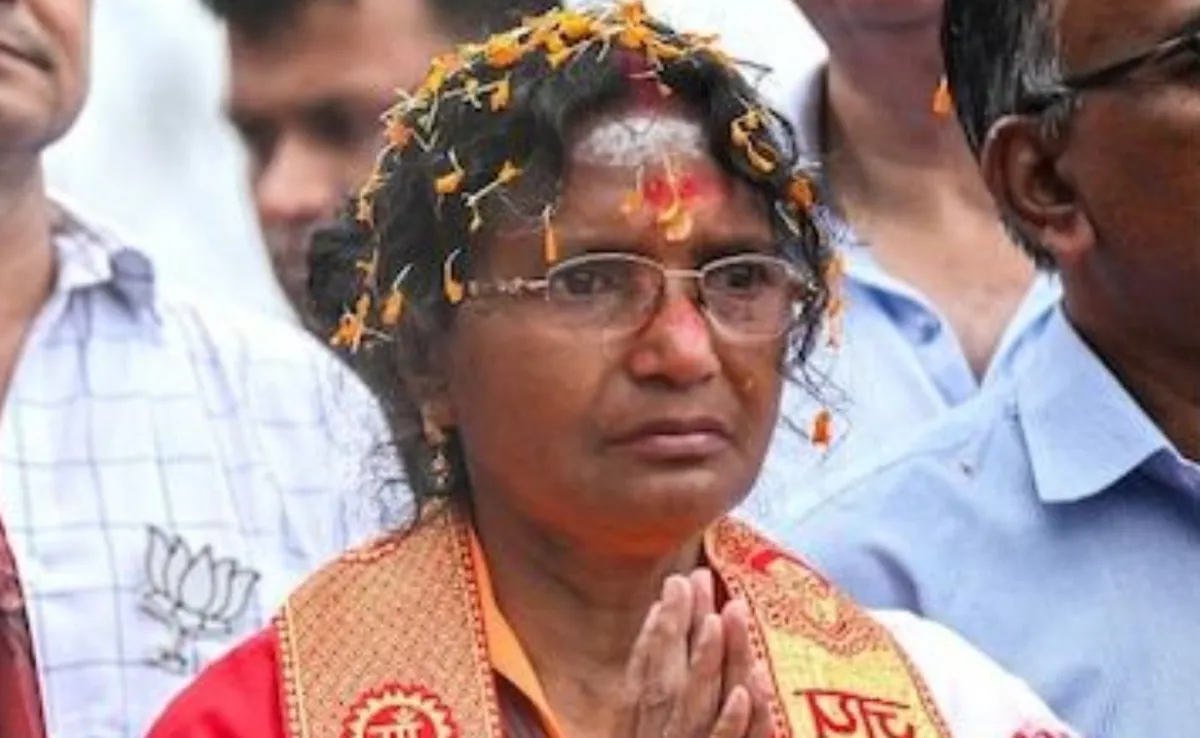
Full Name: Ratna Debnath
Political Party: Bharatiya Janata Party (BJP)
Constituency: Panihati, North 24 Parganas, West Bengal
Known For: Mother of the 2024 RG Kar Medical College rape and murder victim | BJP Candidate | Women’s Safety Activist
Table of Contents
ToggleWho Is Ratna Debnath?
Ratna Debnath is an Indian political activist and BJP candidate who stepped into the national spotlight in August 2024 — not by choice, but through unimaginable grief. The mother of the young postgraduate trainee doctor who was brutally raped and murdered at RG Kar Medical College and Hospital in Kolkata, Ratna Debnath became one of the most recognized faces of the nationwide protests that followed that horrific incident.
From a grieving mother demanding answers to a first-time political candidate contesting one of West Bengal’s most emotionally charged elections, her journey has been anything but ordinary. In the 2026 West Bengal Legislative Assembly Election, the Bharatiya Janata Party fielded her from the Panihati Assembly constituency in North 24 Parganas — a seat historically dominated by the Trinamool Congress. Her entry fundamentally changed the nature of that contest.
Ratna Debnath Wiki – Quick Facts
| Detail | Information |
|---|---|
| Full Name | Ratna Debnath |
| Profession | Activist, Political Candidate |
| Political Party | Bharatiya Janata Party (BJP) |
| Constituency | Panihati, North 24 Parganas |
| Election | West Bengal Assembly Election 2026 |
| Nationality | Indian |
| Religion | Hindu |
| Known As | Mother of RG Kar Victim, “Abhaya’s Mother” |
| Opponent | Tirthankar Ghosh (TMC), Kalatan Dasgupta (CPI-M), Subhashish Bhattacharya (Congress) |
Note: Specific personal details including exact date of birth and formal education qualification have not been officially disclosed in the public domain. This article will be updated as verified information becomes available.
Ratna Debnath Age
Ratna Debnath’s exact date of birth has not been publicly confirmed. Based on available visual and contextual references from media coverage during the 2024 RG Kar protests and the 2026 election campaign, she is estimated to be in her mid-to-late 50s. Official records from her election affidavit filed with the Election Commission of India are the most reliable source for her confirmed age, and this section will be updated once verified data is available.
ALSO READ: Dr Indranil Khan Biography
Ratna Debnath’s Daughter – The RG Kar Case
The name most associated with Ratna Debnath is that of her daughter — a 32-year-old postgraduate trainee doctor who was raped and murdered inside the seminar hall of RG Kar Medical College and Hospital in Kolkata on August 9, 2024. The victim, referred to as “Abhaya” in public discourse to protect her identity, had been working a long shift when the crime occurred.
The case triggered protests that spread far beyond West Bengal. Doctors across India went on strike. Citizens marched in Kolkata, Delhi, Mumbai, and dozens of other cities demanding accountability, safer workplaces for women in healthcare, and systemic reform. The Calcutta High Court transferred the investigation to the Central Bureau of Investigation (CBI) amid sustained pressure from protesters and the medical community.
For Ratna Debnath, the grief never became silence. She became a consistent, dignified, and unflinching public voice — attending press conferences, speaking at protest gatherings, and holding the government accountable at every step. Her daughter’s memory became her driving force.
Ratna Debnath Family & Husband
Ratna Debnath lives in Kolkata, West Bengal. Her husband, whose name has not been prominently disclosed in public reporting, has stood beside her throughout the ordeal following their daughter’s death and during the election campaign. The family has chosen to keep certain personal aspects of their lives out of the media spotlight, which is entirely understandable given the traumatic circumstances under which they were thrust into public attention.
The family’s decision to fight back — first through the courts and protests, and then through electoral politics — has been described by commentators as a remarkable act of courage.
Read More: Sujit Bose MLA TMC Biography
Ratna Debnath Education Qualification
Ratna Debnath’s formal educational background has not been publicly detailed in available sources. What is publicly known is that she is the mother of a postgraduate trainee doctor — a testament to a family that valued education deeply. Her daughter had pursued medicine and was in the advanced stages of her postgraduate training at one of West Bengal’s most prominent government medical institutions at the time of her death.
Ratna Debnath’s Entry Into Politics – From Protest to Panihati
Ratna Debnath did not seek politics. Politics, in a sense, came to her — or rather, the complete failure of political and institutional systems to deliver swift justice forced her hand.
After nearly two years of protests, legal battles, and public advocacy, the Bharatiya Janata Party approached Debnath to contest the 2026 West Bengal Assembly Election from Panihati. She accepted — not as a career politician, but as a mother who had exhausted every other avenue.
At her nomination filing, she was accompanied by senior BJP leaders including Smriti Irani and Biplab Kumar Deb. The scene — a grieving mother filing her nomination amid chants of “Justice for Abhaya” and a sea of saffron flags — became one of the defining images of the entire 2026 Bengal election cycle.
Her own words at that event cut through any political noise: she described her candidacy as a “mother’s duty” — to ensure no other family would suffer the same loss, the same silence, the same institutional abandonment.
Ratna Debnath Constituency – Panihati, North 24 Parganas
Panihati is a suburban assembly constituency located in the North 24 Parganas district of West Bengal. It falls within the Presidency region and sits in the densely populated urban sprawl north of Kolkata. Historically, it has been a reliable Trinamool Congress seat.
Senior TMC leader Nirmal Ghosh had won Panihati for three consecutive terms after first wresting it from CPI(M) in 2011. By 2026, the party fielded Tirthankar Ghosh — son of the veteran leader — to hold the seat. The constituency also saw candidacies from Kalatan Dasgupta (CPI-M) and Subhashish Bhattacharya (Congress), making it a four-cornered contest.
What made Panihati nationally significant in 2026 was not its political history but the emotional weight of Ratna Debnath’s candidacy. Rallies drew large crowds, particularly women and younger voters, who responded strongly to her message of accountability and women’s safety. Her campaign was not built around party manifesto points or welfare schemes — it was built around grief, dignity, and the demand for justice.
Read More: Suvendu Adhikari Biography
Ratna Debnath Election Results 2026
The Panihati election result 2026 produced one of the most watched outcomes in the entire Bengal assembly election.
Ratna Debnath (BJP) secured 41,927 votes, establishing a commanding lead of +15,150 votes over TMC’s Tirthankar Ghosh as counting progressed. The contest was closely watched across all counting rounds — the constituency underwent 13 rounds of counting — and while the early rounds saw some back-and-forth, Debnath’s lead solidified decisively in the latter half.
Her win — in a seat the Trinamool Congress had held for three consecutive terms — stands as one of the most significant individual results of the 2026 West Bengal election. It was not merely a BJP gain. For millions of people across the country who had followed the RG Kar case, it felt like something much more personal.
Panihati 2026 Result Summary
| Candidate | Party | Votes |
|---|---|---|
| Ratna Debnath | BJP | 41,927 |
| Tirthankar Ghosh | TMC (AITC) | ~26,777 |
| Kalatan Dasgupta | CPI(M) | — |
| Subhashish Bhattacharya | Congress | — |
Final certified figures subject to Election Commission of India official declaration.
Campaign Highlights & Key Moments
Women’s Safety as the Core Message: Throughout her campaign, Ratna Debnath kept the focus firmly on women’s safety, institutional accountability, and what she called the “culture of silence” that allows crimes against women to go unaddressed. She never let the conversation drift to generic poll promises.
Support from BJP National Leadership: The party’s central leadership invested heavily in Panihati, viewing the seat as symbolically and strategically important. The RG Kar case had been a persistent liability for the Mamata Banerjee government, and Debnath’s candidacy amplified that narrative organically — without needing manufactured outrage.
The TMC’s Difficult Position: The ruling party faced an unusual challenge. Attacking Ratna Debnath directly risked alienating voters still processing the grief of the RG Kar tragedy. TMC pivoted to a “son of the soil” narrative around Tirthankar Ghosh, emphasizing local development and continuity. It was not enough.
The ‘Abhaya’ Factor: The 2024 RG Kar case — referred to across West Bengal as the “Abhaya incident” — remained the emotional centre of gravity for Panihati voters. Debnath’s campaign tapped into a deeper, unresolved grief that no amount of welfare scheme messaging could fully counter.
Ratna Debnath & The RG Kar Movement
The RG Kar Medical College rape and murder case of August 2024 is among the most consequential crimes in recent Indian history — not because of its singularity, but because of what it exposed: vulnerable women in healthcare settings, institutional attempts to manage narratives, and a government that many believed failed in its duty to act swiftly and transparently.
Ratna Debnath’s voice during the months of protest was notable for its restraint and consistency. She did not become a political instrument during the protest phase — she remained a mother asking for justice. That credibility, built through months of dignified public advocacy, became her greatest political asset when she eventually chose to enter electoral politics.
Her association with the broader justice for Abhaya movement — which had brought doctors, students, and common citizens onto the streets across India — gave her candidacy a moral authority that few first-time political candidates ever carry into an election.
Public Perception & Legacy
Whether one views Ratna Debnath’s political journey through a partisan lens or a human one, certain things are hard to dispute:
- She did not seek the spotlight. It was thrust upon her by tragedy.
- She used that spotlight consistently, and without visible deviation, to demand accountability.
- She entered politics with no prior electoral experience and contested a traditionally hostile constituency — and won.
For the women’s safety discourse in India, her election matters beyond party lines. It signals that voters — especially women — are willing to send a direct message through the ballot when they feel the system has failed them.