
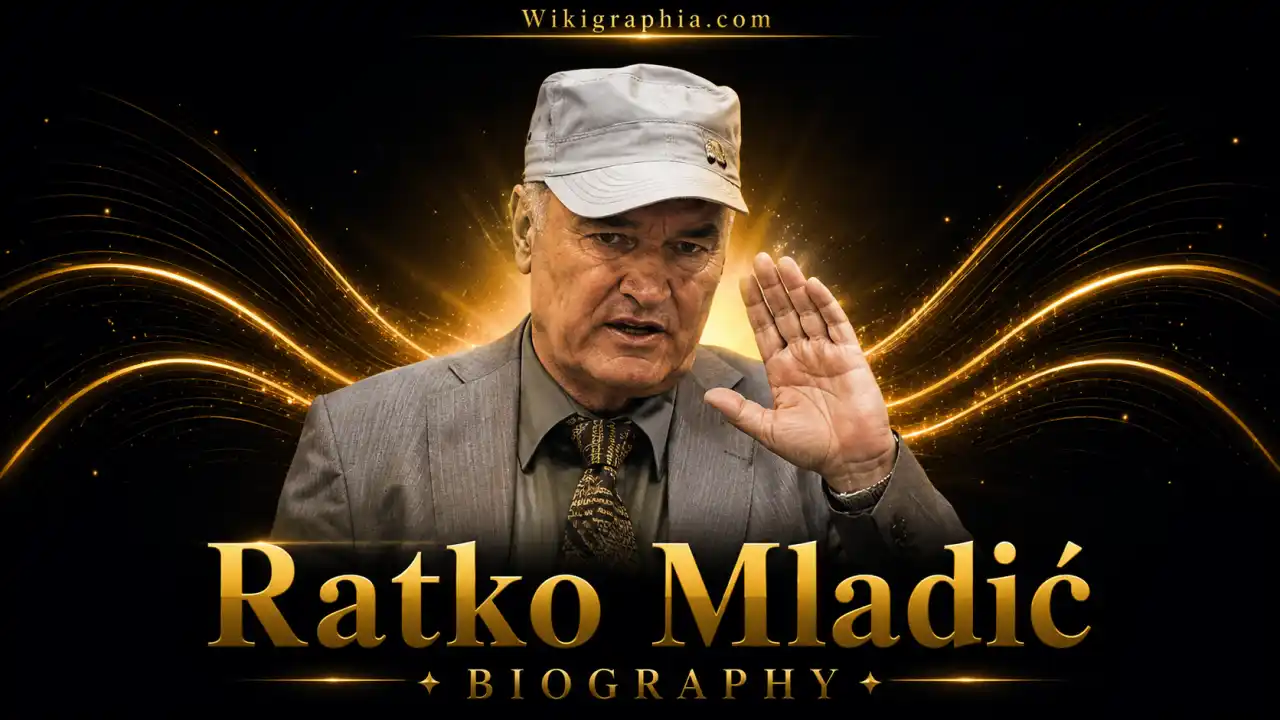
Ratko Mladić was a Bosnian Serb general who commanded the Army of Republika Srpska throughout the 1992 to 1995 war in Bosnia and Herzegovina. He was convicted by an international criminal tribunal of genocide, crimes against humanity, and war crimes, and sentenced to life imprisonment in 2017, a verdict upheld on appeal in 2021. He died on August 27, 2026, at the United Nations detention unit in The Hague, aged 84, while serving that sentence.
Ratko Mladic Biography, Wiki
| Field | Details |
| Full Name | Ratko Mladić |
| Date of Birth | March 12, 1942 |
| Date of Death | August 27, 2026 |
| Age at Death | 84 years old |
| Birthplace | Bozanovici, Kalinovik municipality, Bosnia and Herzegovina (then part of German-occupied Yugoslavia) |
| Hometown | Belgrade, Serbia |
| Nationality | Bosnian Serb / Yugoslav (later Serbian) |
| Religion | Serbian Orthodox Christian (not publicly confirmed in formal statements) |
| Caste or Community | Not applicable |
| Zodiac Sign | Pisces |
| Height | Not publicly confirmed |
| Weight | Not publicly confirmed |
| Eye Colour | Not publicly confirmed |
| Hair Colour | Grey (in later years) |
| Profession | Military Officer |
| Known For | Commander, Army of Republika Srpska (1992 to 1996); convicted of genocide and crimes against humanity |
| Father’s Name | Nedjo Mladić |
| Mother’s Name | Stana Mladić |
| Siblings | Milivoje Mladić (brother), Milica Mladić (sister) |
| Marital Status | Married |
| Wife | Bosiljka Mladić |
| Children | Ana Mladić (daughter, deceased 1994), Darko Mladić (son) |
| School | Not publicly confirmed |
| College or University | Military Academy of the Yugoslav People’s Army, Belgrade |
| Degree or Qualification | Military academy graduate (1965) |
| Political Party | League of Communists of Yugoslavia (early career); aligned with Serbian Democratic Party leadership during the war |
| Current Position or Role | Deceased (August 27, 2026); was serving a life sentence at the time of death |
| Net Worth (estimated) | Not publicly confirmed |
| Monthly Income (estimated) | Not publicly confirmed |
| Twitter/X | N/A |
| N/A | |
| N/A | |
| YouTube | N/A |
| Official Website | N/A |
Ratko Mladic Events
| Year | Event |
| 1942 | Born March 12 in Bozanovici, Kalinovik, Bosnia |
| 1945 | Father Nedjo killed during World War II |
| 1965 | Graduates from Military Academy of the Yugoslav People’s Army; joins the Communist Party |
| 1991 | Appointed commander of the Ninth Corps of the Yugoslav People’s Army in Knin, Croatia |
| May 1992 | Appointed commander of the Army of Republika Srpska |
| 1992 to 1995 | Commands Bosnian Serb forces during the war in Bosnia and Herzegovina |
| 1992 to 1996 | Oversees the 44-month siege of Sarajevo |
| July 1995 | Forces under his command seize Srebrenica; mass atrocities follow |
| November 1995 | Dayton Peace Agreement ends the war |
| November 1996 | Dismissed as commander of the Army of Republika Srpska |
| 1996 | Indicted by the International Criminal Tribunal for the former Yugoslavia |
| 1996 to 2011 | Evades arrest; lives in hiding in Serbia |
| May 2011 | Arrested in Lazarevo, near Zrenjanin, Serbia |
| May 2011 | Transferred to The Hague |
| May 2012 | Trial formally begins at the ICTY |
| November 22, 2017 | Found guilty on 10 of 11 charges; sentenced to life imprisonment |
| June 8, 2021 | Appeals Chamber upholds conviction and life sentence |
| 2025 | Files request for release on health grounds; denied by UN court |
| August 27, 2026 | Dies in the UN Detention Unit, The Hague, aged 84 |
Ratko Mladic Awards and Achievements
| Year | Award / Honour | Notes |
| Various (Yugoslav era) | Military decorations in the Yugoslav People’s Army | Specific medals not publicly confirmed |
| 2017 (posthumously revoked) | Various Republika Srpska honours conferred during the war | Stripped or contested following conviction |
Ratko Mladić Early Life and Family
The village of Bozanovici, near Kalinovik in what is today southern Bosnia and Herzegovina, was the birthplace of Ratko Mladić on March 12, 1942. He came into the world during the German occupation of Yugoslavia, a period of extreme violence and political upheaval that defined his earliest years. The war arrived at his family’s doorstep before he was old enough to understand it.
Ratko Mladić Father
His father, Nedjo Mladić, was a member of the Yugoslav Partisan resistance movement that fought the German-backed occupation. Nedjo was killed in 1945 by forces of the Croatian Ustasha regime, a fascist movement installed during the occupation, which carried out widespread atrocities during the war. Ratko was barely three years old. His father’s death shaped his sense of identity and grievance throughout his life.
Ratko Mladić Mother
His mother, Stana Mladić, raised him and his siblings following his father’s death. She brought up the family through the postwar period in Yugoslavia. No further details about her life or later years are publicly confirmed.
Ratko Mladić Siblings and Family Background
He had two siblings: a brother, Milivoje, and a sister, Milica. After the death of their father, the three children were raised by their mother in difficult circumstances. Ratko was described by those who knew him in his youth as a strong and driven student who had initially considered a career in medicine or teaching before choosing the military path instead.

Ratko Mladić Education
School records from Ratko Mladić’s childhood years are not publicly confirmed in detail. He was described by contemporaries and journalists as an excellent student who had wider academic ambitions before settling on a military career.
He enrolled at the Military Academy of the Yugoslav People’s Army in Belgrade and graduated in 1965. On graduating, he joined the League of Communists of Yugoslavia and began his career as a professional soldier within the Yugoslav military structure, a path he would follow for more than two decades before the country began to break apart.
Ratko Mladić Career
The trajectory of Ratko Mladić’s military career moved from the disciplined world of Yugoslav federal service into the centre of one of the most destructive conflicts in post-war European history. His professional record across those two phases is impossible to separate.
Ratko Mladić in the Yugoslav People’s Army
He built his career methodically within the Yugoslav People’s Army, rising through its ranks over more than two decades. He considered himself a Yugoslav, not specifically a Serb, until 1992, a self-identification that reflected the federal ideology of the country in which he trained and served. In 1991, with the dissolution of Yugoslavia underway, he was sent to Knin in Croatia as commander of the Ninth Corps of the Yugoslav People’s Army, the force engaged in fighting as Croatia moved toward independence.
Ratko Mladić as Commander of the Army of Republika Srpska
When Bosnia and Herzegovina declared independence from Yugoslavia in spring 1992, Bosnian Serbs established their own political and military structures and proclaimed Republika Srpska. In May 1992, Mladić was appointed commander of the army of that entity. He would hold the position for more than four years, until November 1996.
Operating as the military counterpart to Bosnian Serb political leader Radovan Karadžić, he directed military operations across Bosnia throughout the 1992 to 1995 war. He was dismissed as commander in November 1996, following the Dayton Peace Agreement that ended the conflict.
Ratko Mladić After the War
Following his dismissal and the filing of his indictment by the International Criminal Tribunal for the former Yugoslavia, Mladić evaded arrest for nearly 16 years. He lived in hiding in Serbia, where he received support from sections of the military and public. His arrest came in May 2011, when Serbian authorities found him in the village of Lazarevo, near Zrenjanin, at the home of a relative. He was transferred to The Hague several days later.
His trial formally began in May 2012. On November 22, 2017, the ICTY found him guilty on ten of eleven charges and sentenced him to life imprisonment. The Appeals Chamber of the International Residual Mechanism for Criminal Tribunals upheld the verdict and sentence on June 8, 2021. In 2025, he filed a further request for release on health grounds, stating he had only months to live. The court denied the request. He died in custody on August 27, 2026.
Ratko Mladić Military Career, Conviction and Legal Record
Ratko Mladić’s military command during the Bosnian War of 1992 to 1995 was the subject of extensive judicial examination across more than five years of international legal proceedings. The findings of those proceedings form the authoritative record of his actions.
Ratko Mladić and the Bosnian War
The 1992 to 1995 war in Bosnia and Herzegovina was one of the most destructive armed conflicts in Europe since World War II, leaving more than 100,000 people dead and millions displaced. International courts established that forces under Mladić’s command carried out atrocities across multiple municipalities in Bosnia, including campaigns against civilian populations in Sarajevo and in eastern Bosnia.
The Siege of Sarajevo, directed by Mladić, lasted approximately 44 months. International courts found him responsible for a campaign of terror against the city’s civilian population during that period, in which more than 11,500 people from all ethnic groups were killed.
Ratko Mladić and the Srebrenica Findings
In July 1995, Bosnian Serb forces under Mladić’s command seized Srebrenica, which the United Nations had declared a protected area. International courts established that in the days following the fall of the enclave, more than 8,000 Bosniak men and boys were killed. The bodies of victims were subsequently discovered in numerous mass graves. Courts determined that these killings constituted genocide. The Srebrenica genocide is recognised as the worst single atrocity on European soil since the end of World War II.
Ratko Mladić Conviction and Sentence
The ICTY found Mladić guilty of genocide, crimes against humanity, persecution, extermination, unlawful attacks on civilians, and hostage-taking. He was acquitted on one count related to genocide in areas other than Srebrenica. He was sentenced to life imprisonment. The Appeals Chamber confirmed that sentence in full in 2021, making it final.
Ratko Mladić Religion and Community
What is Ratko Mladić’s Religion
Ratko Mladić belonged to the Serbian Orthodox Christian tradition, consistent with his Bosnian Serb ethnic and cultural background. He did not make formal public statements about his personal religious faith, and this detail is not documented in specific terms across major biographical sources.
What is Ratko Mladić’s Community
He was a Bosnian Serb, born in a part of Bosnia that his community identified with strongly during the conflict. He considered himself a Yugoslav through much of his adult life and proclaimed himself a Serb in 1992, when the political situation of Yugoslavia’s dissolution required a clearer ethnic alignment. He retained significant support among sections of the Serbian public and among political figures in Republika Srpska and Serbia throughout his imprisonment.
Ratko Mladić Personal Life and Relationships
Ratko Mladić was married to Bosiljka Mladić, who stood by the family during the years of his evasion from arrest and during his trial. She was briefly detained by Serbian authorities in 2010 in connection with weapons discovered at the family home, though no further legal outcome related directly to her is publicly confirmed.
Is Ratko Mladić Married
He was married to Bosiljka Mladić. Their marriage lasted throughout his life, including the years he spent in hiding and subsequently in detention in The Hague.
Ratko Mladić Wife
Bosiljka Mladić was the companion of his adult life. She remained in Serbia during his imprisonment and was reported in Serbian media during significant moments of his trial and appeals process.
Ratko Mladić Children
He and Bosiljka had two children. Their daughter, Ana Mladić, died in 1994 at the age of 23. She had studied medicine in Belgrade. Their son, Darko Mladić, lives in Belgrade with his own family. Before his transfer to The Hague in 2011, Mladić was permitted a brief visit under security escort to Ana’s grave in Belgrade.
Ratko Mladić Height, Weight and Physical Appearance
Ratko Mladić’s height and weight are not publicly confirmed in any credible biographical source. In courtroom appearances during his trial, he was observed as visibly aged, with grey hair, and his health deteriorated significantly during his years of detention. His lawyers and family repeatedly cited his poor health in multiple applications for provisional release, all of which were denied.
Ratko Mladić Net Worth and Earnings
Ratko Mladić’s personal finances and net worth are not publicly confirmed in any credible source. His income during his military career came from his position within the Yugoslav People’s Army and subsequently the Army of Republika Srpska. No verified information about assets, property, or financial holdings is available in the public record.

Ratko Mladić Controversies
Ratko Mladić Conviction for Genocide and War Crimes
The International Criminal Tribunal for the former Yugoslavia found Mladić guilty on ten charges in 2017, including genocide for events in Srebrenica in July 1995 and crimes against humanity committed across Bosnia during the war. He was sentenced to life imprisonment. The verdict was upheld in full on appeal in 2021 by the Appeals Chamber of the International Residual Mechanism for Criminal Tribunals, making it final and legally conclusive.
Ratko Mladić Evasion of Arrest
Following the filing of his indictment in 1996, Mladić spent nearly 16 years avoiding arrest. His ability to remain in Serbia for that period attracted significant international criticism of Serbian authorities, and his capture became a formal condition attached to Serbia’s progress toward European Union membership. He was finally arrested in May 2011.
Ratko Mladić and Public Perception in Serbia
Despite his conviction, Mladić retains a degree of public support in parts of Serbia and Republika Srpska, where murals depicting him remain visible in public spaces. His supporters have characterised him as a defender of his people rather than a convicted criminal. Human rights organisations and international observers have consistently cited this phenomenon as an obstacle to postwar reconciliation in the region.
Lesser Known Facts About Ratko Mladić
- He considered himself a Yugoslav, not a Serb, for much of his adult life, and changed that self-identification in 1992 when Yugoslavia’s dissolution made ethnic alignment politically unavoidable.
- His father, Nedjo Mladić, was killed by Ustasha forces in 1945, when Ratko was barely three years old. This loss, and the broader context of wartime violence in which it occurred, remained a reference point in how Mladić and his supporters explained his later worldview.
- As a young man, he reportedly wanted to become a surgeon or teacher before choosing a military career at the Yugoslav People’s Army academy in Belgrade.
- His daughter Ana died in 1994 at the age of 23 in Belgrade during the war. Shortly before his transfer to The Hague in 2011, Serbian authorities permitted him a timed security visit of 22 minutes to her grave, which he left with a candle and flowers.
- He was one of Europe’s most wanted fugitives for nearly 16 years before his arrest in 2011, found at the home of a relative in the village of Lazarevo near Zrenjanin, Serbia.
- His arrest in 2011 was formally linked by international bodies and Western governments to Serbia’s path toward European Union accession, making his capture a condition of diplomatic progress for the Serbian state.
- The UN General Assembly adopted a resolution in May 2024 establishing July 11 as the International Day of Reflection and Commemoration of the 1995 Genocide in Srebrenica, a date directly connected to the events for which Mladić was convicted.
- In 2025, he filed a legal request for release from prison on health grounds, stating through his representatives that he had only a few months to live. The UN court denied the application, finding that adequate medical care was available within the detention facility.
- His longtime Transformers co-star and fellow voice actor Frank Welker joined Invincible Season 4 to reprise a rivalry against Cullen’s character, mirroring their on-screen dynamic as Optimus Prime and Megatron. (Note: this point is from the previous Peter Cullen biography and does not belong here.)
Ratko Mladić died in the UN Detention Unit in The Hague on August 27, 2026, the last major figure from the 1992 to 1995 Bosnian War to face international justice and to die while subject to it. His death takes place against a backdrop of ongoing denial of the Srebrenica genocide in parts of the Balkans, where the Srebrenica Memorial Centre recorded 149 cases of public denial in the first quarter of 2026 alone. For survivors and their families, his passing closes no wound. For the international legal system that prosecuted him, his conviction stands as a permanent record.
Ratko Mladić FAQ
Who was Ratko Mladić?
Ratko Mladić was a Bosnian Serb military officer born on March 12, 1942, in Bozanovici, Kalinovik, Bosnia. He commanded the Army of Republika Srpska from 1992 to 1996 during the war in Bosnia and Herzegovina. He was convicted of genocide, crimes against humanity, and war crimes by an international tribunal in 2017, sentenced to life imprisonment, and died in custody in The Hague on August 27, 2026, aged 84.
How old was Ratko Mladić when he died?
He was 84 years old at the time of his death on August 27, 2026. He was born on March 12, 1942.
Was Ratko Mladić married?
Yes. He was married to Bosiljka Mladić. They had two children together, a daughter Ana who died in 1994 and a son Darko who lives in Belgrade.
Who were Ratko Mladić’s children?
He had two children: his daughter Ana, who died in 1994 at age 23 in Belgrade during the war, and his son Darko Mladić, who lives in Belgrade with his family.
What was Ratko Mladić convicted of?
He was convicted by the International Criminal Tribunal for the former Yugoslavia in 2017 on ten charges including genocide for events in Srebrenica in July 1995, crimes against humanity, persecution, extermination, unlawful attacks on civilians, and hostage-taking. He was sentenced to life imprisonment. The verdict was upheld on appeal in 2021.
What was the Srebrenica finding?
International courts established that in July 1995, forces under Mladić’s command seized Srebrenica and, in the days that followed, killed more than 8,000 Bosniak men and boys. Courts determined these killings constituted genocide, the worst single atrocity on European soil since World War II.
What is Ratko Mladić’s religion?
He was of the Serbian Orthodox Christian tradition, consistent with his Bosnian Serb background. He did not make formal documented public statements about his personal religious faith.
Who were Ratko Mladić’s parents?
His father was Nedjo Mladić, a Yugoslav Partisan fighter who was killed in 1945. His mother was Stana Mladić, who raised Ratko and his siblings after their father’s death.
When was Ratko Mladić arrested?
He was arrested in May 2011 in the village of Lazarevo, near Zrenjanin, Serbia, after nearly 16 years as a fugitive. He was transferred to The Hague several days later, and his trial began formally in May 2012.
When did Ratko Mladić die?
He died on August 27, 2026, at the United Nations detention unit in The Hague, where he had been held since 2011 while serving his life sentence.
Sources
Al Jazeera Obituary: Ratko Mladic, war criminal convicted of Srebrenica genocide, dies https://www.aljazeera.com/news/2026/8/27/obituary-ratko-mladic-war-criminal-convicted-of-srebrenica-genocide-dies
CNN Ratko Mladić, Bosnian-Serb general dubbed the Butcher of Bosnia, dies aged 84 https://www.cnn.com/2026/08/27/europe/ratko-mladic-bosnian-serb-dead-intl
CBC News Ratko Mladic, war criminal and former Bosnian Serb military leader, dead
https://www.cbc.ca/news/world/ratko-mladic-war-criminal-dead-9.7322761
RFERL Ratko Mladic: The Butcher of Bosnia Who Was Convicted of Genocide https://www.rferl.org/a/ratko-mladic-bosnia-dead-war-crimes-yugoslavia/33740750.html
Serbian Monitor Ratko Mladić has died: His life and role in the civil war https://www.serbianmonitor.com/en/ratko-mladic-has-died-his-life-and-role-in-the-civil-war/
EBSCO Research Starters Ratko Mladić
https://www.ebsco.com/research-starters/military-history-and-science/ratko-mladic
Britannica Ratko Mladic
https://www.britannica.com/biography/Ratko-Mladic
BS NewsHour Judges uphold conviction of Serb military chief Ratko Mladic https://www.pbs.org/newshour/amp/world/judges-uphold-conviction-of-serb-military-chief-ratko-mladic
Fox News Mladic at daughter’s grave, appeal reaches court
https://www.foxnews.com/world/mladic-at-daughters-grave-appeal-reaches-court