
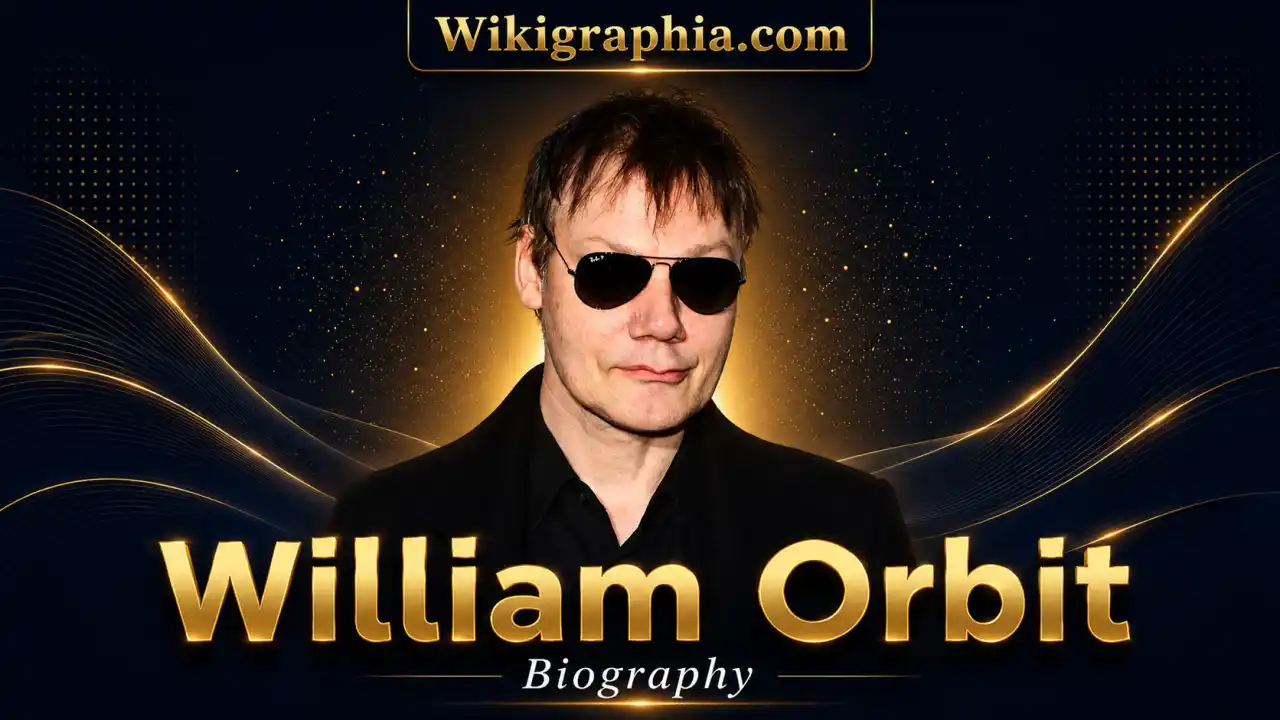
William Orbit was an English musician, record producer and remixer widely regarded as one of the most innovative figures in electronic and pop music. Best known for producing Madonna’s landmark 1998 album Ray of Light, a record that reshaped mainstream pop by fusing it with electronica and won multiple Grammy Awards, he was a pioneer of atmospheric, ambient-influenced production. Across a career of more than four decades he worked with a remarkable range of artists, released acclaimed solo work, and achieved chart success in his own right. He died on 23 July 2026 at the age of 69.
William Orbit Biography, Wiki
| Field | Details |
| Full Name | William Mark Wainwright |
| Known As | William Orbit |
| Date of Birth | 15 December 1956 |
| Date of Death | 23 July 2026 (aged 69) |
| Birthplace | Shoreditch, East London, England |
| Nationality | British (English) |
| Zodiac Sign | Sagittarius |
| Profession | Musician, record producer, remixer |
| Known For | Producing Madonna’s Ray of Light |
| Years Active | Early 1980s to 2026 |
| Genres | Electronica, ambient, dance, pop |
| Early Bands | Torch Song and Bassomatic |
| Solo Alias | Strange Cargo |
| Grammy Recognition | Ray of Light won multiple Grammy Awards |
| Notable Solo Hit | Barber’s Adagio for Strings (1999) |
William Orbit Production and Musical Work
| Artist or Project | Detail |
| Madonna | Produced Ray of Light (1998), Music (2000) and MDNA (2012) |
| Blur | Produced the album 13 (1999) |
| Solo (Strange Cargo) | A series of instrumental and ambient albums |
| Torch Song | Electronic trio in the early 1980s |
| Bassomatic | His dance project of the early 1990s |
| Other collaborators | U2, Pink, Britney Spears, Blur and more |
William Orbit Events
| Year | Event |
| 15 December 1956 | Born in Shoreditch, East London |
| Early 1980s | Formed the electronic trio Torch Song |
| 1986 | Created the soundtrack for the film Youngblood |
| Early 1990s | Achieved dance success with Bassomatic |
| 1998 | Produced Madonna’s Ray of Light |
| 1999 | Produced Blur’s 13 and charted with Barber’s Adagio for Strings |
| 23 July 2026 | Died at the age of 69 |
William Orbit Early Life
William Orbit was born William Mark Wainwright on 15 December 1956 in Shoreditch, in the East End of London. He learned to play the guitar as a teenager and began performing in and around London and Paris, immersing himself in music from a young age. His early experiences as a performer and his growing fascination with electronic sound laid the foundation for the pioneering production career that would follow.

William Orbit Career
William Orbit’s Early Bands and Solo Work
William Orbit first emerged in the early 1980s as a member of the electronic trio Torch Song, formed with his friends and collaborators Laurie Mayer and Rico Conning, releasing several albums on the IRS label. He soon moved into production and also launched a prolific solo career, recording a series of largely instrumental, atmospheric albums under the name Strange Cargo, which featured guest vocalists including Beth Orton. In the early 1990s he was the creative force behind the dance project Bassomatic, further establishing his reputation in electronic music.
William Orbit’s Breakthrough with Madonna
William Orbit’s career reached its defining moment when he was chosen to produce Madonna’s seventh studio album, Ray of Light, released in 1998. Madonna, long an admirer of his solo records and his remixes of her work, sought to fuse a futuristic electronic sound with other influences, and Orbit’s atmospheric, electronica-infused production helped create one of her most acclaimed and commercially successful albums. The record was a landmark that brought electronic textures firmly into mainstream pop, and it won multiple Grammy Awards, transforming Orbit into one of the most sought-after producers in the world.
William Orbit’s Work with Blur and Others
William Orbit followed his success with Madonna by producing Blur’s experimental 1999 album 13, as the band sought to move away from their earlier Britpop sound. The album yielded hits including “Tender” and “Coffee & TV,” and, as with Madonna, Blur had first been drawn to Orbit through his remixes of their music. Over his career he worked with an impressive array of artists, including U2, Pink, Britney Spears and No Doubt, and he reunited with Madonna on later projects such as her albums Music and MDNA.
William Orbit’s Success as a Recording Artist
William Orbit also established himself as a successful solo recording artist. In 1999, he gained considerable attention with his trance-inspired version of Samuel Barber’s “Adagio for Strings,” featured on his album of electronic adaptations of classical music. Four years later, he worked with singer Pink on the song “Feel Good Time.” Through his solo projects, Orbit combined classical influences with ambient and electronic sounds, demonstrating the versatility of his musical creativity beyond his acclaimed work as a producer.
William Orbit’s Legacy
William Orbit left a profound and lasting mark on popular music. His pioneering fusion of electronica, ambient textures and classical influences with mainstream pop helped define the sound of the late 1990s and early 2000s, and his production of Ray of Light in particular is widely regarded as a landmark that reshaped pop’s relationship with electronic music. Remembered by collaborators and admirers for his creativity, his kindness and the many lives he touched through his music, he influenced a generation of producers and artists who followed.
William Orbit Personal Life
William Orbit was known within the industry for his warmth and generosity as much as for his talent. Following his death, his family described him as someone who would be greatly missed by the many people whose lives he had touched through his music, his friendship and his kindness, and asked that the privacy of his family and close friends be respected. He kept much of his private life out of the public eye, with his public identity centred on his music.
William Orbit Net Worth and Earnings
A reliable, verified figure for William Orbit’s net worth is not a significant part of the public record, and this profile does not put forward one. His income came from his long career as a record producer, remixer and recording artist, including his acclaimed production work for major artists and his own solo releases and chart hits. His significance lies in his musical influence and legacy rather than in documented wealth.
| Source | Detail |
| Net worth | Not reliably documented |
| Main income sources | His production work, remixes and solo recordings |
William Orbit Social Media
William Orbit maintained a presence connected to his music, and it was through his social-media accounts that his family announced his death. News of his life and legacy has been shared widely across the music world and by the many artists he worked with.
| Platform | Handle | Notes |
| Social media | His official accounts | Where his passing was announced |
| Public tributes | Artists and music media | How his legacy has been honoured |
William Orbit Controversies
No significant personal controversy involving William Orbit surfaced in the material examined for this profile. He was widely respected and admired within the music industry, and coverage of him has focused on his groundbreaking production work, his artistry and the affection in which he was held rather than on any scandal.

Lesser Known Facts About William Orbit
- His real name was William Mark Wainwright.
- He was born in Shoreditch, in London’s East End.
- He created the soundtrack for the 1986 film Youngblood.
- He recorded solo albums under the name Strange Cargo.
- Madonna discovered him through his earlier records and remixes.
- His reworking of Barber’s Adagio for Strings was a 1999 hit.
- His production of Ray of Light won multiple Grammy Awards.
William Orbit FAQ
Who was William Orbit?
He was an English musician, record producer and remixer, best known for producing Madonna’s landmark 1998 album Ray of Light.
When was William Orbit born, and when did he die?
He was born on 15 December 1956 and died on 23 July 2026, at the age of 69.
What was William Orbit best known for?
He was best known for producing Madonna’s Ray of Light, a Grammy-winning album that fused pop with electronica.
What other artists did William Orbit work with?
He worked with Blur, U2, Pink, Britney Spears and No Doubt, among others, and reunited with Madonna on later albums.
What was William Orbit’s real name?
His real name was William Mark Wainwright.
Did William Orbit release his own music?
Yes, he recorded solo albums under the name Strange Cargo and had hits including his version of Barber’s Adagio for Strings.
What bands was William Orbit in?
He was a member of the electronic trio Torch Song and led the dance project Bassomatic.
How did Madonna come to work with William Orbit?
Madonna was a fan of his earlier solo records and his remixes of her work, and tapped him to produce Ray of Light.
Where was William Orbit from?
He was born in Shoreditch, located in London’s East End.
How is William Orbit remembered?
He is widely regarded as an influential producer whose combination of electronic and pop music helped transform the mainstream sound.
Sources
Rolling Stone, William Orbit, Grammy-Winning Producer of Madonna’s ‘Ray of Light,’ Dead at 69
https://www.rollingstone.com/music/music-news/william-orbit-producer-madonna-ray-of-light-dead-obituary-1235605106/
Deadline, William Orbit Dead: Producer Of Madonna’s ‘Ray Of Light’ Was 69,
https://deadline.com/2026/08/william-orbit-dead-1237028473/
Gold Derby, Remembering William Orbit, Grammy-winning producer behind Madonna’s ‘Ray of Light’,
https://www.goldderby.com/music/2026/william-orbit-ray-of-light-dead-greatest-hits-madonna-pink-blur/